
Distillation Diaries: "False Agave"
I’m not a botanist, I don’t even have a garden, and my potted plants at home oscillate between being parched and waterlogged. Everything I have learned is from working directly with distillers and farmers throughout Latin America since 2015, when I relocated to Perú. I am a distiller and have a master’s degree in food studies. I am fascinated by the way we interact with plants and how, over millennia, we have developed innovations that allow them to feed us, heal us, and even inebriate us, helping us transcend realities.
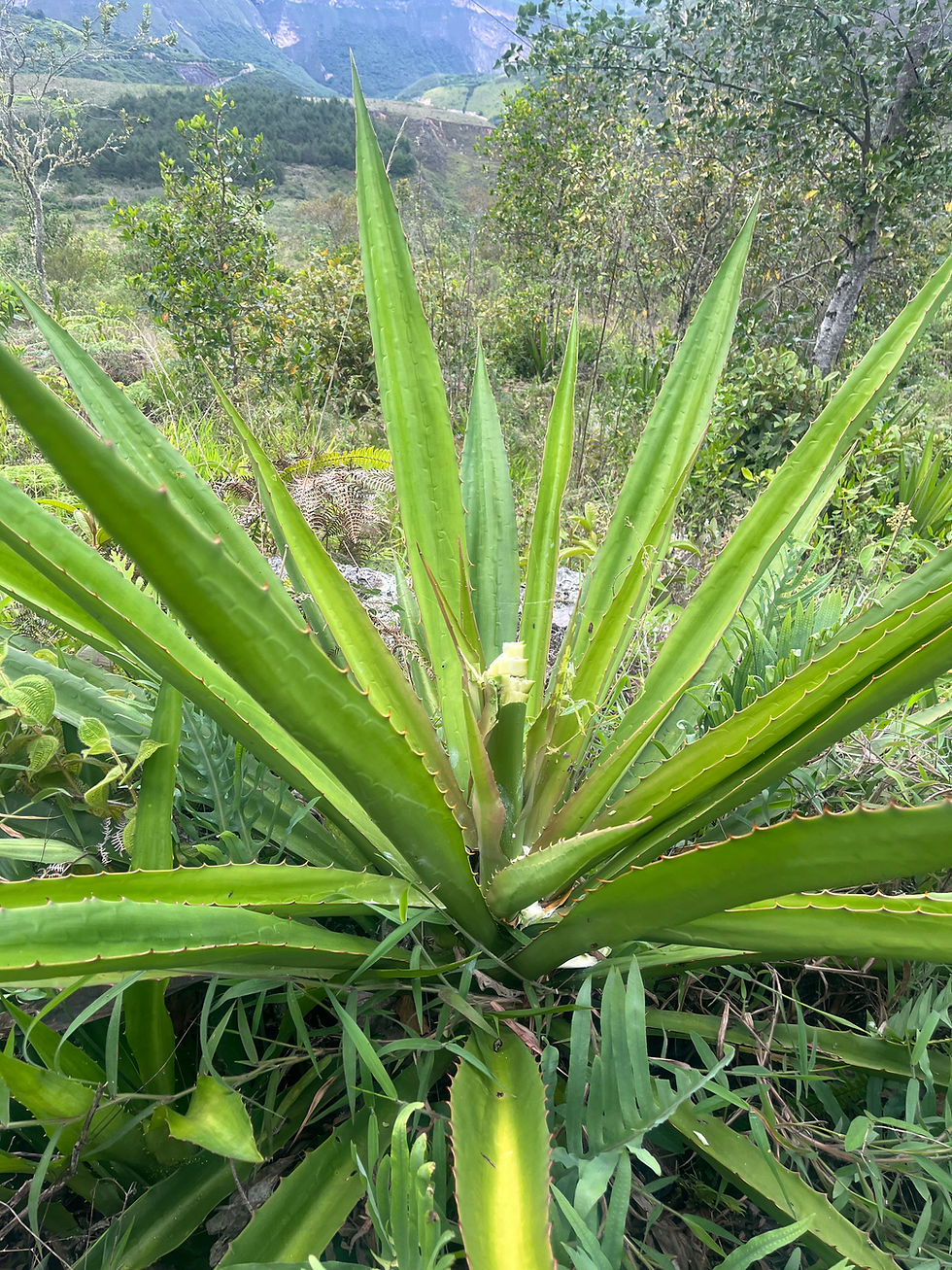
In Cocachimba, where Gocta Lab is located, the “cabuya” or “penca” (Furcraea andina) is plentiful. In another part of the Amazonas department, not far from Cocachimba, artisans use its leaves for fibers to make bags and other products for sale, a project that started around fifteen years ago to drive tourism and promote rural development. The fiber from the cabuya is called fique. It has been used since time immemorial in the Andes as a locally produced rope with endless practical applications.
Furcraea is a genus, part of the Asparagaceae family. It is monocarpic, meaning it reproduces once via flower and dies. The same family as the Agave, but a separate genus entirely. Furcraea are considered “false agaves,” with roughly 25 species endemic to the Americas. Furcraea andina is specific (obviously) to the Andes.
The life cycle of a F. andina is about 10 years. Coincidentally, during my month-long residency at Gocta Lab, three pencas along the road leading down to the lab were just beginning their flowering process. As the plant enters its reproductive phase, it channels all of its energy into shooting up a massive flower stalk, ultimately sacrificing itself to spread its genetics. To delay the sacrifice, we cut the flower stalk to reconcentrate the plant’s energy for our own selfish ambitions. I wanted to explore the possibility of distilling the penca, employing the same processes I have seen for years in agave spirits production or even whisky production. We would need to simplify the long-chain polymers through hydrolysis in order to ferment and convert sugars into alcohol. Distillation, of course, just peels away water, solids, and other undesirables. With our prototyped distiller built and functioning, it was time to put local ingredients to the test. Penca was just one of the local materials that I had access to at the remote lab - to read more, see my piece on yacon and pitahaya. My month-long investigation established initial production methods for their transformation into spirits, a small but meaningful first step in the broader scheme of things.
I feel it’s important to note that this project is not driven by commercial intentions, but seeks to answer a couple of questions. Could we develop a spirit made with local ingredients that reflects Pirqapata Lab’s commitment to 0 km sourcing? Could we create a product that truly represents the Utcabamba Valley while encouraging agriculture in a region overly dependent on the inherent fickleness of tourism?
I’ve spent all of my adult life engaging with spirits as a bartender, a distiller, a formulator, and a brand strategist. This time, I would be a resident at Pirqa Pata Lab, free to explore the limits of my creativity in beverage design, from ideation to end product. Leading up to the start of the residency, I resisted the urge to pre-plan what I would make; instead, I wanted to listen, learn, and observe with my feet on the ground and allow myself to become inspired sensorially.
We would have to build a still. Fortunately, I was staying with ceramists. Out of local and historic Huancas pottery, we created our distiller. A Frankenstein. And it worked.
My conclusions about processing — cooking methods and times, fermentation temperatures, and distillation — remain open-ended, still under investigation. This was an illuminating first inquiry into the possibilities, and, on a personal level, a chance to get intimately close to what it means to bring an agave-like spirit to life.
Read more on the process below:
PROCESS:
12/9:
Capamos una planta con su flor recién saliendo (aquí se le llama “maguey” al palo o flor)
12/19:
Measured sugar content: 12 Brix
With a refractometer, the penca measured at 12 Brix. Raw materials for spirits production measure above 20; grapes around 24 Brix for pisco, and agaves for tequila production typically have between 25 and 30 Brix.
12/24:
Harvested penca
9.33 kilos of heart + leaves
3.26 kilos of root/stem
PENCA NOTES:
The harvest alone reaffirmed for us that nothing worth doing is easy. The leaves came off, and we carried the heart of the Penca back to the lab to weigh and break it down into smaller pieces that would a) fit into the pressure cooker and b) to test cooking times (documented below).
COOKING:
#1 12/24: Olla exprés 1 hour + presión approx . 15 psi
No medí la pieza, ni la cantidad de agua antes de cocer
Se ve dirty, 1st hour is “penca car wash?”
Water contains 2 brix / 483.6 g
1062.9 grams of cooked(and cleaned) penca
#2 12/25: Olla exprés 2 hour + presión 15 psi
1062.9 grams of penca + 1 liter of water
Stopped at 1.75 hours because it smelled like it was burning a little bit
1:30 pm opened the pot - no water left, penca burning to the bottom. Did not add a platform in the olla.
850.5 grams cooked
#3 12/25: Olla exprés 1 hour + presión 15 psi
2502.5 grams uncooked (pre-cleaned) penca
1 Liter of water (add more - up to 4 Liters)
Opened at 4 pm - looks good!
+3 Liters of water + 2 hours
2.25 liters of “oven honeys” 2 brix
#4 12/26: Olla express 1 hour + 15 psi
2500 grams (2.5 kilos) of uncooked penca
1 Liter of water - to clean
Open + 3 Liters of water + cook for 2.5 hours
1.2 Liters of oven honeys 1.5-2 brix
Up to this point cooked + processed = 3.23 kilos - add equal amounts of water.
#5 12/27: Olla express 1 hour + 15 psi 1 liter agua
2027 grams of raw penca
Dumped water after one hour
Added penca back with 3 L of water - cook 3 hours.
2060 grams of cooked penca
1.1 Liters of oven honeys 1.5 - 2 brix
TOTAL: 4797 grams (4.797 kilos processed agave) + 4261 grams (4 Liters of oven honeys, approx 2 brix.)
FERMENTATION:
12/28 - 5 brix ( I think this figure will increase by later today)
12/28 pm 6 brix after further shredding and agitation
12/29 pm 5 brix
1/1 pm: 5 brix - it’s cold! Placed in koji -warmer ambient temperature
1/ 2 am: 3 brix - turned off bulb, 27C
1/ 2 4 pm: turned on bulb
1/ 3 pm: 2.5 brix 2.5 Liters jugo, 1.5 kilos fibers per distillation - fermentation not finished, but time is up.
PENCA NOTES:
January 3rd: my last day at the lab, so I decided to distill everything. Distillation is a preservation method, making the ferment shelf-stable. At the very least, it is the first entry for Gocta Spirits that others can build upon.
To read more about the other things we distilled and how we built the still, see more on the Project Destilador post.
SOURCES


Comments